What Lakunea is
A permissionless network of settlement nodes that verify payment payloads and clear on-chain for any prevailing open machine-payment standard — with identity, credit, and policy state the standards leave undefined.
Protocol White Paper · 2026
The settlement execution layer for the machine economy.
Verifiable agent identity, underwritten machine credit, and multi-rail clearing for transactions expressed in open machine-payment standards.

00 · Abstract
Machine-payment standards specify formats and authorization semantics. They do not specify who clears, who vouches for agent identity, who extends credit to software with no balance, or how value reaches providers outside the dollar core.
A permissionless network of settlement nodes that verify payment payloads and clear on-chain for any prevailing open machine-payment standard — with identity, credit, and policy state the standards leave undefined.
Native settlement and fuel unit. Node admission requires bonded LKUN. Every settled transaction consumes a fee in LKUN — base burned, priority to the executing node. Credit underwriting capital is posted in LKUN beneath a senior stable tranche.
Ecosystem emission unlocks against verified, identity-attested, non-self-dealing settlement volume — not against elapsed time. Absent verified volume, no emission occurs.
01 · Market thesis
x402, the Machine Payments Protocol, and AP2 define how software requests payment. They do not decide who clears it, who vouches for the agent, or who extends credit before funding.
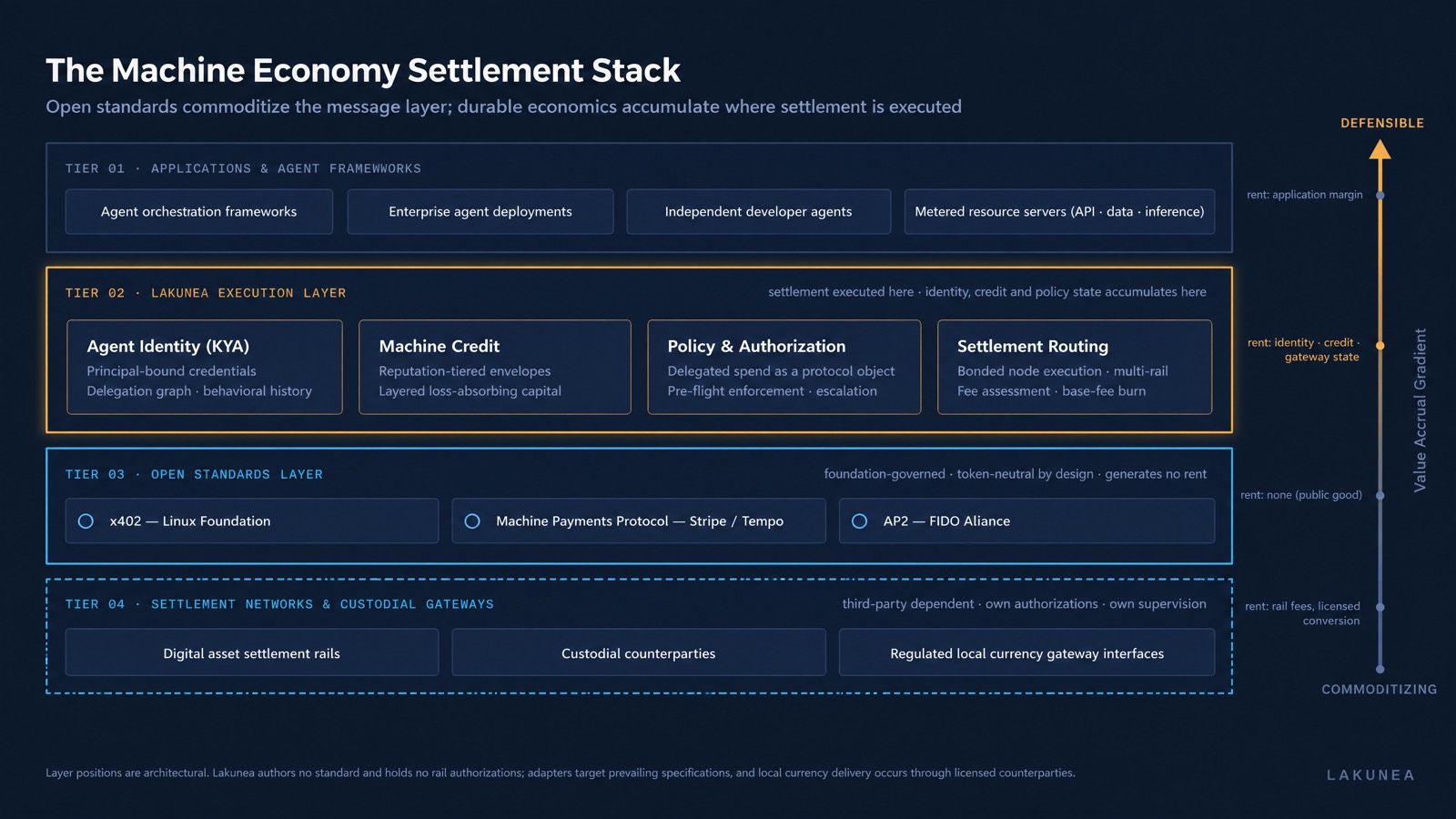
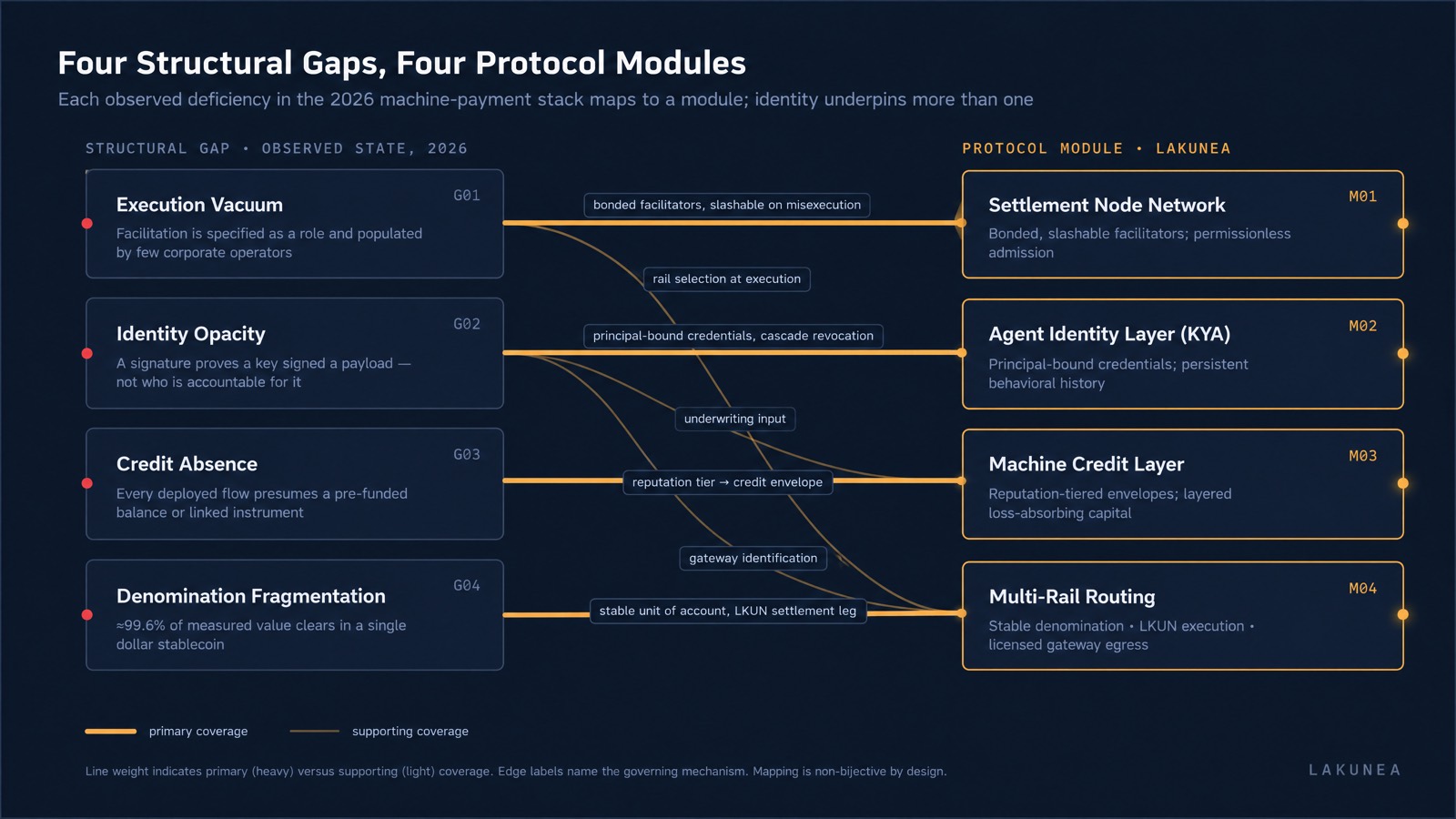
Facilitation is a role populated by a handful of corporate desks. Scale needs bonded, permissionless nodes — not a small set of clearing desks.
A signature proves a key signed a payload. It does not name the principal, the mandate, or whether prior conduct warrants access.
Every live agentic flow assumes pre-funding. Human commerce runs on standing. No network prices behavioral history into a drawable envelope.
Measured agentic value clears almost entirely in one dollar stablecoin. Providers outside that perimeter lack a first-class path to usable local value.
02 · Definition
Lakunea is a settlement execution network. It verifies, clears, and records machine-originated payments — and maintains the identity, credit, and policy state that makes those payments attributable.
02 · Protocol
Each module closes one structural deficiency the standards layer, by construction, does not address.
Principal-bound credentials, delegation graphs with cascade revocation, and reputation tiers derived from verified settlement outcomes — not from wallet balance.
Reputation-tiered envelopes let reputable agents transact before funding. Junior LKUN capital sits under a senior stable tranche, with circuit breakers on loss.
Delegated spend travels as a protocol object. Pre-flight checks permit, deny, or escalate before any payload is signed or any on-chain operation begins.
Bonded nodes verify, select rail and mode, burn the base fee, and route payouts — including through licensed local-currency gateways they do not themselves operate.
03 · Design principles
A node that verifies a payment and authorizes delivery before finality extends a short-duration guarantee. Bonded stake sized against throughput, with slashing for misexecution, distinguishes a settlement network from a verification API.
An unidentified counterparty cannot be underwritten. An economy where every agent must pre-fund every transaction stays a fraction of one where standing can substitute for balance.
Providers price in stable value; the protocol settles in LKUN. Atomic conversion at the settlement boundary keeps those functions separate.
Any metric that gates emission must resist manufacture. The integrity filter feeds the emission contract, with exclusion criteria that remain governance-auditable.
Some properties are cryptographically proven; others are attested, monitored, or only contractually enforced. Treating them as equivalent misstates the protocol's guarantees.
05 · LKUN
Services price in stable value. LKUN executes the on-chain settlement leg, bonds nodes and underwriters, and meters identity and credit-tier consumption.
The ecosystem tranche — the largest — unlocks only on verified commercial volume. Calendar alone never releases it.
Every cleared transaction executes its on-chain leg in LKUN. There is no settlement path that bypasses it.
Network fees, node bonds, junior underwriting capital, and identity registration all consume or lock LKUN.
Any supported standard and any supported asset still generate LKUN-denominated network fees when Alliance nodes clear the flow.
08 · Development horizons
Capability maturity advances when verification criteria clear — not when a quarter ends.
Core settlement engine, standard adapters, identity registry, policy engine, canonical supply ledger, bonded node set.
Netted and voucher modes, multi-gateway custodial settlement, first corridor interfaces where licensed counterparties integrate.
Credit facility under staged envelopes, mirrored chain representations, additional corridors, enterprise policy tooling.
Veto sunset and full protocol governance, adjudicated disputes at scale, redundant gateway coverage, selective decentralization of issuance.
Explore by module
Each page covers a distinct layer of Lakunea — from market thesis to token economics and delivery horizons.
Four structural gaps the standards layer leaves undefined.
02 · ProtocolThe four load-bearing modules that close those gaps.
03 · ArchitectureNormalized instructions, bonded nodes, delivery before finality.
05 · LKUNFixed supply, three-ring utility, milestone-gated emission.
07 · GovernanceConstitutional limits, parameter bands, veto sunset by criteria.
13.1 · Contributor StructureFour technical mandates and the Research and Advisory Council
08 · Development horizonsCapability gates from engine launch to full governance.
Identity before credit. Credit before scale. Measured volume only when it survives the integrity filter.